Showing posts with label A look at suffering. Show all posts

Thursday, March 24, 2011

A Look at Suffering - Part Ten - Putting It All Together

So what exactly does all this mean?

Well, for one it means that faith is tougher than we might have first thought - though we usually learn this an even harder way.

It also means that we are more important than we tend to give ourselves credit for.  Yes we are to be humble, and serve, and not put ourselves first, but that doesn't mean we don't have a battle to fight!

God wants, dare I say NEEDS, our help - okay, so in the end he doesn't, but he does ask for our participation.

As my Grandpa would say: participate, don't be part of the problem.

Sometimes by sitting out, or staying away, or letting go and letting God we are inadvertently being part of the problem.

We aren't meant to sit this one out.  We are in the game, we all have a role, a position to play.

Why is there suffering?

Because there are agents and people that are out to do evil - and succeed.

What can we do?  We can fight back.

Our weapons?

Prayer and love.

I know, not the weapons I would chose either, but in all honesty they ARE the most effective.  Perhaps not in the short run, but in the long run - in the run that counts - they are VERY effective.

They are the weapons Jesus used.  And if they are good enough for him...

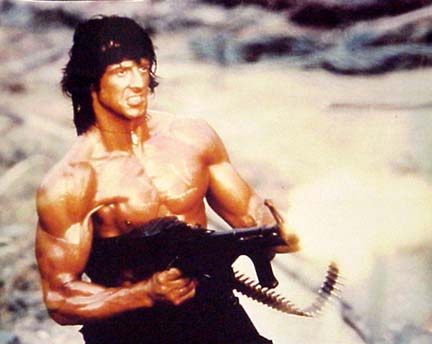
We want to be Rambo and mow down the bad guys one-arming an M-60...maybe that's just me...But that's not what we are asked to do.  We are asked to do something much, much, MUCH more difficult - I think you know what that is.

And while this won't answer why anyone suffers for any specific reason, I hope that it gives you a bit broader perspective on God and why in general people suffer and how we can and do effect what happens in this world - maybe even the world to come.

Take care.

Wednesday, March 16, 2011

A Look at Suffering - Part Nine - What Can We Do?

The Sea of Ambiguity, Boyd calls it.

Paul said it was like looking through a glass darkly...

In other words: we catch glimpses of what is going on, what is happening in the world and in the "world" around us.

Through the other posts, we have discovered that there is more going on than what we see...more than we could possibly know or understand.

Evil exists for many reasons...for many other, hidden, reasons God can't stop the evils from happening.  Nor can he stop the suffering.

Evil is easy to see when it happens to other people, suffering is harder to explain when it happens to you.

But we know it is NOT God's will that evil exists, and persists, nor suffering.

There is much at work, causing and effecting much of what goes on in the world, and whether we can point it our or not - we too, add to this confusion...especially when we stray off our path of following Jesus.

But, in the midst of all this confusion, ambiguity, and darkness is there anything we can do?  Do we even make a difference?

The answer is: YES.

And it's so simple, we overlook it more often than not.

Boyd puts it like this, "There is one more extremely important variable that conditions God's activity in any particular situation."

That variable is PRAYER.

When I first read this, I almost poo-pooed it right off.  Prayer?  Really?  I know I should pray and I do...but then I began to think...why should I pray?

Just to talk to God?  Tell him my wants and needs? (like new tires)  To learn His will for my life?

While they are good, they aren't IT as it comes to prayer.

Prayer has been touted as something that helps us, change us.

God doesn't need our prayers...we need do.

After all, would a truly all-powerful God need anything from us?  Most of us would answer: no.

But Boyd states that this, "variable is about the kind of world God decided to create."

In the previous posts, we only skimmed the surface as to what kind of world this is, the world He created.

Boyd continues, "Scripture teaches that God created a world in which he has significantly bound himself to the prayers of his people."

Jesus seems to agree to this point.  He does teach us a certain prayer: the Lord's Prayer.

In the Lord's Prayer we pray to God that his will be done "on Earth as it is in Heaven."

This would seem to imply, or only make sense, if God's will WAS NOT being done on a consistent basis.

Not only that, but as Boyd points out, Jesus wants us to pray as if God doesn't want to answer our prayers. (Luke 11:5-13; 18:1-8)

Obviously God wants to hear our prayers, but to command it, there must be a good reason...evidently, we might hold a bit more sway than we first thought.

But, we might then ask, why would God created such a world that prayers effect what he can/can't do?

Boyd explains it as this: "Prayer is simply the spiritual side of our morally responsible say-so."

In other words, what we can physically change through our actions (free will) we can spiritually effect as well through prayer.

Does that mean that all our prayers will be answered as we wish?

Of course not...in fact, the prayers God seems to answer seems again...arbitrary at best.

But why?

Why would, does, God answer one prayer over the other.  More to the point, why does God seem to answer flippant prayers by non-pious, non-church going folks, yet won't answer a heart felt, knee-bent, crying out prayer of say...me?

This is another unanswerable questions in terms of specifics.  In general,  it is because of all the other variables taking place...all the other prayers, the other people, the other angels, the other demon, the other you-name-it.

There is much going on in this cosmic war.

But through the authority of Jesus, we can and should have faith that prayer, ALL PRAYER moves God's will further along.

However, we may never see this either.

Perhaps our prayer WAS answered, just not in the way that we would like it to be answered, or expected it to be answered.

Again, specifically, for a certain situation we may - most likely won't - ever know.

But, for me, that is a hard pill to swallow.  Not because I don't believe it, but because I don't like it.

Yet, this is the world that God created.  A world full of risk...and love.  And reluctantly I would agree that it is worth the risk.

Boyd goes on to list 9 variables as it pertains to prayer.  I won't go into them, but I will list them.

1.  God's will.
2. Faith of the person being prayed FOR.
3. Faith of the PEOPLE praying for.
4. Persistence of prayer.
5. Number of people praying.
6. Human free will.
7. Angelic free will.
8. Number and strength of spirit agents.
9. Presence of sin.

Most of these, I'm guessing, you can immediately see how they might affect our prayers.  Others are a bit more complicated.

But we must always remember:  this sea of ambiguity that we are living in, this dark glass we look through is NOT completely because of our fallen world, but because our of FINITE knowledge.

That is: our knowledge while here on earth, does have limitations.

Perhaps on the other side, we'll get a clearer picture...at least, we can pray for that.
Thursday, March 10, 2011

A Look at Suffering - Part Eight - A Look at Us...

Up 'til now, we've looked at God and his "role" in suffering in the world.  If you haven't read the previous posts, I suggest that you do - just so things are in context.

Through the previous posts we now know: that we know very little.  Very little about what is truly going on in the world.  Sure, we know it isn't how it's supposed to be, but we don't fully know why it is the way it is.

Nor do we fully know why God can stop some evils from happening and not others.

But we do know: Evil is NOT God's will.  And that we can trust God did what he could and that He CAN bring good out of evil.

What we have yet to look into is our role in suffering.

This isn't a fun one to look at.  We'd rather not admit that we do very little, in the grand scheme of things to alleviate the world of evil.  Nor, would we like to admit that we allow for it to exist and happen.

We hate that it happens...but what do we really do about it?

We point our finger at God and ask him why he doesn't do something about it.  Or we shrug our shoulders and say it's just "God's will."

There is a benefit to that: it relieves us of any and all responsibility.  Evil isn't our fault, it's only the fault of evil people.

But is that true?

Is that what Jesus taught us?

I would argue that our actions/inactions have much, much more to do with suffering than we would care to admit - even under duress!

After all, aren't we all good people?  We certainly like to think we are, and some people even tell us we are!  We don't condone evil, in fact we condemn it!  I shake my head at it when I see it on TV and say, "How awful."

I can hardly see any conceivable way that I  have anything remotely to do with the evils and tragedies in the world - especially the big ones, like genocide in Darfur...heck I'm waaaaaaay across the globe, right?

We might not like to, but we do have to admit it: we allow evil to exist and happen every day.  Our inactivity from doing good, strengthens evil.  When we turn a blind eye to injustice.  When we say, "That's someone else's problem."  When we chose not to help someone because they look like a drunk, or a druggie, or...

Heck, I can list twice as many reasons I "SHOULDN'T" help someone than why I "SHOULD."  Some days - more than I want to admit - the shouldn'ts win out.

But if we are truly followers of Jesus: there isn't anyone who falls under the "shouldn't".  Nobody doesn't deserve help.  There are no reasons not to help when you can.

Either we are all God's children, thus all one family, or we are not.

God didn't give us ANY wiggle room.

Cain asked, "Am I my brother's keeper?"

The answer is YES!

And we can't truly start to help people until we are honest with ourselves regarding the lack of LOVE we give and the amount of EVIL we allow.

Evil doesn't have to be grand, big, headline making tragedies...evil can, and is, a snide remark, a flip of a finger, a word said to hurt, a slap across the face...

No, we don't have to get down on ourselves - that helps no one - but let's not just shrug it off either.

As the saying goes, whenever you point a finger at someone (even God) there are three pointing back at you.

A Look at Suffering - Part Seven - Is God to Blame?

Putting together everything we've discussed in the previous posts we should be able to answer: no.

But, even still for me, it's hard to accept that God would allow evils to exist, let alone happen.  The murder of thousands, the murder of one child, the earthquake in Haiti...and the list goes on.  We all have our lists, personal and public of tragedies that have happened and we look to God and ask: why?!

So let's make it clear: God DOES NOT WILL any of these tragedies to occur.

This is clear from the beginning of the Bible and quite a main point in Jesus' ministry.

The question we are still left with is "why?"

Boyd reminds us that, "Knowing...that freedom must be irrevocable and that a vast, unknowable complexity engulfs every event in history helps us understand in principal why God cannot do more in general.  But precisely because every event is engulfed in an unknowable complexity, we can never understand why God didn't do more in any particular circumstance."

So in short: the "why" may never be fully answered.  Even if it could be, it no doubt wouldn't be to our satisfaction.

Boyd continues, "Given our myopic vision we can only fix our eyes on Jesus and trust that God looks like Him...And when [evil] isn't prevented, we trust Him to bring good out of it."

This isn't to say it's easy.  At times, especially at times of tragedy, faith is difficult.

It's hard to believe that God CAN'T do something.  That God CAN'T prevent something, especially evil, from happening.  In that sense, isn't God to blame?

Again, the issue isn't truly about his power.  To say it bluntly: there ISN'T anything God CAN'T do, as it pertains to power, brute force, ability.

But there are things God can't do as it pertains to character.

The issue becomes, then, do we agree with God's plan of risk or not?  Do we agree with God that love, to be real and honest, must be a choice and not coerced?

We do.

Parents do it everyday...allowing their children a life of LOVE and RISK.  And as time goes on, more and more risk.

Do we hold parents culpable for everything their child does?  Especially the adult "children?"

Do YOU want to control every aspect of your child's life?  Most likely, because you want to keep them safe...yet, a life YOU control is no life FOR them - and we know this.  Moreover, we much prefer that our children have a life of their own...which means: risk.

Yet it is, perhaps, the most perfect example of LOVE.

How much MORE perfect, then, is God's love?

But how does this reflect his character?

We have faith that God will do everything he can, within the conditions he has created, to keep evil from happening...yet, knowing that God holds himself to these constraints means that we can trust him completely, because he DOES NOT act arbitrarily.

Would you trust a person that acted any way they wanted, at any time, just because they felt like it?  No, of course not.  We trust certain people because we have seen how they act in certain situations.  In other words, because we know that person has put restraints upon themselves on how they act.  We then can TRUST how that person will act in certain situations.

Is that not how we would like our relationship with God to be?  To know that we can count on God to act in accordance with His character as revealed to us through Jesus?

Unfortunately, given the complexity of the world, how God is "able" to operate is not so cut and dry.  But we can know, and have faith and trust, that God did not act arbitrarily but with perfect clarity and perfect character.

I don't like that, but I do accept it.  I don't like not KNOWING why...but I trust in God that He did everything He could to prevent it, and in no way did He WILL it.

And when there is significant doubt, and there will be, THAT is when we fix our eyes on Jesus and remember, that when we see Jesus we see God.

Saturday, March 5, 2011

A Look at Suffering - Part Six - Why God CAN'T stop the pedophile...

(NOTE: please DO NOT base your theology upon the following.  I am just a regular Christian like you, trying to sort out issues of faith.  I CLAIM no authority over the Bible or God.  Any "answers" I may provide are NOT the basis for doctrine, but are solely my beliefs and opinions.  Any quotes I use by Boyd or other authors, I use as I best understand them.  Any miss use of the quotes are my fault, and should not reflect upon the original authors.)

I think it's time that we cut to the point.

Why is there suffering?

Or what we really want to know: Why doesn't God stop a pedophile from preying upon a child.

I use this example, because it's one I'm sure we all agree reflects the nature of evil.

The question still, even now, makes me pause for a moment and wonder...

Why would an ALL GOOD and LOVING God allow ONE SINGLE child to suffer in such a way?

Certainly and ALL POWERFUL God COULD stop it from happening...Dare I say, SHOULD stop it from happening.

And, there is evidence that He DOES stop it from happening...by why not all the time?

So, why does and ALL LOVING, ALL POWERFUL God allow such evil to occur?

(Before we even try to answer these questions, we must know this: there is no easy answer to them.  There is no cut-and-dry, this is why answer.  In fact, we may only generally know the answer, but will never specifically know.

But we MUST, MUST remember this:  it IS NOT God's will that this should happen.  We must NEVER lose our picture of who God is, as revealed to us through Jesus.  This can be, will be, tough...)

"What he can hardly begin to fathom, however, is the vast complexity of creation, a creation that includes an untold number of human and spiritual free agents whose decisions affect much that comes to pass." - Boyd.

In other words...there's more going on than just what we see or experience.

We must remember that God's goal is ultimately LOVE.  But in order for there to be true love, in all it's forms, there must be risk.  This risk is manifested by God granting us free will.

Not only us, but of spiritual agents as well - angels, demons.

We can choose God's way, or not.  We see evidence of both every day.  Those we could argue that more to the "not" side than the other.

As in the case of the child.

Now, think a moment, how much our hearts break when we hear such tragedies.  Especially when we couldn't do anything to stop it.

How much more must God's heart break; especially when He CAN.

But why doesn't he?

The short answer: He CAN'T.  Not always.

But not for reasons that we would think.

God "can't" not because He lacks the strength, or the power...make no mistake He does.

God "can't" because that's not the world he created.

God didn't create a world in which he can and does thwart free will as he sees fit.  God created a world that involved RISK and DANGER.  And yes, we become causalities of this.

But it's not God's fault, though God does take responsibility.

Boyd describes it more clearly this way, "God could have created a world in which his will is always done...however, a world in his will is possibly NOT done would have been ruled out....this means he would have ruled out a world where (true) love is possible."

He continues, "Conversely, if God decided to create a world where love IS possible, he thereby ruled out a world in which his will is ALWAYS done...he can't guarantee that his will is always done, not because he lacks power but because of the kind of world He created."

He can't do more than He does because the world HE CREATED prevents him from doing so.

To give it a more simplistic example: God CAN'T make a round triangle.  Doing so would make is a circle.  A triangle is a triangle because it ISN'T anything else - it's a triangle.

If God arbitrarily intervened at any time, anytime He wanted, He would be violating His world of free will...we would only be allowed to make decisions, we wouldn't be free to.

This wouldn't be a world of freely given love.

To intervene at will would change the world he created...thus it would NOT BE the world he created.

Isn't this a reflection of His lack of power?

By no means.

This is what Boyd calls the requirement of irrevocability. (say that ten times fast!)

"Love involves choice.  This means that God can't revoke agents' freedom when the act in unloving ways.  If God were to revoke our freedom...we wouldn't be truly free...He has to give [freedom] irrevocably.  God can't intervene to stop it.  He has to tolerate it.  Not because He lacks the power...but because this is what it means to give genuine freedom to agents."

BUUUUUUTTTTT!

This DOES NOT mean God can NEVER stop an agent from doing something.  However, me MUST and DOES stop short of coercion.  Persuasion, though, is fair game.

But, there's another but...Boyd says, "This...doesn't rule out other agents using their own freedom to prevent an agent's actions or from canceling the effects of that agent's decisions."

This irrevocable freedom that we, and other agents, are granted does not LIMIT God's power.

Boyd says, "God's power is not the issue.  The issue is the kind of world God decided to create and its logical implications."

What is at issue is, "WE don't know how much irrevocable freedom God has granted any individual and thus how much God HAS TO tolerate the ongoing effects of that individuals evil choices.  There is NO reason to think God gives the same amount of freedom to everyone or that the scope of this gift is fixed throughout a person's life...We can only know that to the extent that God has give free will, he can't revoke it."

This, however, does not answer the reason why any SPECIFIC evil occurs, only in general.  Thus, we must keep our focus on God and who he has revealed himself to us through Christ.  And when evil does occur we must trust in God and have faith that he will bring good out of it.

Thursday, March 3, 2011

A Look at Suffering - Part Five - A War?

Again, the cornerstone of our faith is based upon how we view God.


We've taken a look at the Blueprint Worldview - the predominant view of Christian's and the Church - that states: everything that happens in the world is ordained, if not allowed, by God for the accompliment of His will, or "secret plan."

But Boyd offers us a different view of God.  A view, he argues, is more aligned with with what we see in Jesus.

Boyd writes, "Jesus didn't come to declare that everything already manifests the Father's will.  He came, rather, to establish the Father's will, because the world as it now is doesn't consistenly manifest God's will."

Is there any argument there?

All it takes is five minutes of watching the nightly news or reading the top stories of today's paper to prove this.

Thus, Jesus' ministry is not one of a blueprint God but of an embattled God.

Boyd states, "Jesus' ministry reveals a warfare worldview in which God wars against those what oppose him."

A war against, "powers and principalities" as Paul says.  A war against those who would oppose his will.

In short, a war against Satan.

Boyd asks, "How are we to make sense of this fact?  How could the omnipotent God's creation become a war zone in which he has to genuinely fight to establish his will?"

Especially against Satan, and in light of God being "all-powerful?"

While a search to find answers to these questions may help us to understand the nature and reasons of suffering, the answers will fail in answering them completely.

However, "So long as we think of God's greatness in terms of sheer power, there is no adequate answer to these (any) questions."

If God is at war what does that mean for us?  What is our part?  What else might be going on that we don't understand?  How does this answer suffering?

Does it answer suffering?

Wednesday, March 2, 2011

A Look at Suffering - Part Five - Dignity of Risk

In my profession, we have an ongoing challenge of ensuring a person's safety, while under our care, while allowing them AS MUCH freedom as possible.  We call this the dignity of risk.

Meaning, that we must allow for the person to make some decisions that may not be in their best interest.  Such as smoking, or drinking alcohol (with their given medications) be out alone in the community, etc.  Things you and I take for granted.

It's a funny way of putting it, but it is true - we, you and I, have the dignity of risk.  We, in most ways, get to risk our "lives" or at least our "safety" everyday.  There's no one here, right now, watching my every move to see if I "can" or "can't" do something that might put me at risk...

God works the same way.  He give us the dignity of risk.


Or, as Boyd puts it: the risk of love.

We've heard it before "God is Love." (1 Jn 4:8,16)

He made the world from His love to share in His love.

As we all know, however, love cannot be forced...it must be freely given, and freely chosen.

This means, a person can say "no" to love.

Boyd tells us that "Up to the time ot Augustine the church understood and emphasized this point...they taught that God's mode of operation in running the world is not coersion but persuasion."

This is risky, though.

Because it allows for one to NOT CHOOSE love.  Which also allows for the possibility of...evil.

We can see this in our owns lives: love is risky.

We put out hearts our there, no knowing for sure if the other person will reciprocate our love...or even treat us with love.  While we don't want the other person to treat us badly, we don't want to FORCE them to love us either.  We want them to have "free will" to love us.

Why?

Because then we'd would know their love wasn't genuine...we want genuine love.

Wouldn't God want the same?

If God's will is to be carried out in love, and he allows us to have free will to do so, it also means he allows us to have free will NOT to do so.

In other words, as Boyd says, "...we can refuse to carry out his command (will) if we choose."

This means, to put it bluntly, we can choose NOT TO follow God's will...

A belief quite contrary to what most of the church is teaching.  I would bet that if you asked most people if they believed God's will could be thrawted by us, they would say, "no."

After all, God is all-powerful!

How could we, meere humans, keep God's will from happening?  An all-powerful God wouldn't allow that to happen...would He?

Well, if God wants us to love him freely, and to love freely, he can't FORCE us to love Him or others...thus his "wants" and what we "do" may not line up.  That would mean His will (want) was not being accomplished.

So does this mean he ISN'T as all-powerful as we believe?

Of course not.

What does it mean?

It means much more is going on than we realize...or perhaps, want to believe.

Sunday, February 27, 2011

A Look at Suffering - Part Four - The Blueprint

"...directly or indirectly everything in world history follows a meticulous divine blueprint...The ultimate reason why anything happens is that God decided it was better to have it happen than not...At the very least it can be said that each event in world history happens because God willed not to prevent it."

The above is how Boyd describes the The Blueprint Worldview.

While he may have named it, the belief is far from new.

In fact, Boyd points out this worldview goes back to the days of Augustine (the 5th century) and is still quite popular in the church even today.

I can attest to hearing some sermons that have preached this view.

The pastor, or whomever, will use words like "providence" and "immutability" and "will" etc.

Augustine even believed that those who found themselves victims of "evil" by the hands of others to find consolation that there must have been a greater good, as God would not have allowed it to happen.

Calvin called it God's "secret plan."

A plan so secret, there isn't even a hint of it in the Bible - outside of God will eventually win.  But what's the point of winning if the game is rigged and you created it?

How does worldview fit into real life?

Boyd gives an example.  A woman Boyd knew had lost her child to a drunk driver.  To console her, she had been told by fellow Christians that "God had his reasons" and "God is still in control."

As Boyd puts it, "...(it's) as though the drunk driver was actually carrying out the will of God!"

Just another part of God's "secret plan."

This is where the Blueprint Worldview has an issue.  There is no REAL answer to evil and tragedy, except to say there MUST have been greater purpose for it.

A greater purpose that we may never understand or know of.  We are just to trust that God has his "secret plan" and it's working out HIS way...

Of course, "For some people the assumption that God allows tragic events for a specific divine reason has understandably produced rage."


But this begs the questions - why does it HAVE to be this way?

Why couldn't God, if he is so powerful and everything happens because of Him, make His will, His divine plan come about in a different way?

How come God can't bring about His plan without any of us suffering?

If it is all for the greater good, why - at the very least - can't he explain to us how it contributes to the greater good...or at least give us a hint?

The questions keep on coming...no doubt you have some of your own (feel free to same them in the comments).

Boyd also points out: how can God punish someone for doing evil if He is the one that ordained the person to commit the evil - or at the very least allowed it?  To say nothing of "ordaining" or "allowing" Adam and Eve to eat of the forbidden fruit - which "condemned" us all.

"And it's difficult to accept that people in hell somehow contribute to the overall good of creation."

Personally, I must say that is hard for me to accept that God ordains and allows evil to not only exist, but seemingly run rampant in this world.

Yet Boyd asks, "Does denying a specific divine reason for every specific event mean that God is not all-powerful?" and "What are we to make of Bible passages that depict God as orchestrating suffering and evil?"

Very good questions.

Friday, February 25, 2011

A Look At Suffering - Part Three - That Darned Tree

"In the beginning..."

No need to grab your Bibles, I'm sure we all know, or at least have a fairly good idea how the beginning of Genesis reads.

Long/short of it: God makes everything, including Adam - then Eve from Adam - and then puts in this weird tree type thing.

The Tree of Knowledge of Good and Evil.

God grants Adam and Eve use and enjoyment of EVERYTHING, but this ONE, SINGLE, SOLITARY tree.

This is what Boyd calls The Loving Prohibition.

At first read I thought, "Whaaaaa?  How's that work?"

Thankfully Boyd explains.

At the center of the relationship with God is two-fold.  The provision and the prohibition.

The provision is pretty self explanatory.  It's the Tree of Life.  Loving fellowship with God in all it's forms.

The prohibition is a bit tricky - as the last thing WE want is to be told we CAN'T have something.

Yet, that's EXACTLY what we need.

Thankfully, again, Boyd explains.

I would guess that all of us would agree that there is a difference between God and us.  Some more obvious than others.

One of those differences, as Boyd points out, is that we ARE NOT life's "ultimate moral judges."  And for that we should be REALLY thankful - in that regard, I think we all would agree: we suck.

To be moral judges is not our role.  God didn't create us to be such.

We are to be reflections of God's heart...his love...his will - if you will.

We aren't able to do this, Boyd states, if we are trying to be like God and taking over the role of moral judges.

As Boyd says, "We simply are not equipped to make accurate and loving judgments about good and evil....Our experience and perceptions of reality are incredibly narrow....We are incapable of drawing definitive conclusions about most things, especially the state of people's hearts."

But, we didn't buy into God's way.  We bite into the fruit of the tree everyday...

If you think for a second, like I did, that you wouldn't have eaten of that tree: just remember, we do it everyday, most of the time without thinking.  Still don't believe me?  Watch how selfish you are from sunrise to sunset tomorrow.  Heck in the next five minutes!

Me?  I'm a saint! (yeah, right)

Nope, we eat of the fruit everyday...all day sometimes.

Why is this prohibition good for us?

Boyd sums it up quite brilliantly: "God wants our life to be one of receiving and giving unsurpassable love.  But this requires that we refrain from judgment."

When I read this I want to say "Amen!" and "What the heck?" at the same time.

I don't get to JUDGE people?

But it's so FUN!  I mean, there are some people that are just ASKING to be JUDGED and dang it I want to be the one to waggle my finger and JUDGE them...

But, Boyd (and God) is right...we can't truly start to love one another until we stop judging everyone.

I have to admit this is hard - heck just yesterday (though I'm sure I did it today too) I was judging someone.  I know, because I was trying NOT to.  The more I tried NOT to, the more they kept "giving" me reasons to judge them.

Boyd states that "the most important aspect of faith is our mental picture of God."

How true it is...

He then says, "Amidst the sea of ambiguity (life) we swim in, we must not relay on our own "knowledge of good and evil" to figure out what God is like and what he is up to."

So, perhaps, my view of God might not be all that I thought it was...or hoped it was...If it's so easy for me to judge others, well judging God isn't that far of a leap either.

As tasty as this fruit is...it might not be so good (or fun to eat) after all...

A Look at Suffering - Part Two - God's Blueprint?

In Is God To Blame? Boyd tells us a story of a woman, Melanie.  Melanie wanted to be a mother more than anything in the world.  She married later in life and to make sure they had a family they immediately began trying to have a baby.  Though, later, they found out that it would be near impossible for Melanie to conceive due to a medical condition.

But, just when they were about to give up hope - Melanie became pregnant!

All went well with the pregnancy...until the birth.  Due to complications, the baby die during child birth.

To say Melanie and her husband were devastated is clearly and understatement.  Melanie fell into a depression.

To look for answers Melanie turned to a respected Bible teacher they knew.

The answer she got was what she expected:  God has a reason for everything.  There are no accidents in God's providence.  The hand that smites is the hand that heals.  You just have to trust him."

Melanie further asked what good God might have intended with this tragedy.  She was told, "When God's timing is right, and when you have learned what you are meant to learn, God might bless you with another child.  Or it wasn't HIS WILL for you to have children." (emphasis mine)

Boyd learned of Melanie's situation when she came to him for help.  Not in understanding "why" she lost her baby, now she wanted to figure out what lesson God wanted her to learn.

Is it any wonder that Melanie lost her zeal, her love for not only God, but of life?

But that was Melanie's picture of God.  That is many people's picture of God.

Even I had that picture of God.  An all powerful, all knowing God that, if he wanted could stop ANY and ALL tragedies that happen - thus if a tragedy did happen, God had a very good reason to LET it happen.

Many people have lost their passion for God because their picture of God does not foster passion.  They believe, as Boyd writes, "Everything that happens (in the world) would be the working out of His plan."

Including Melanie's tragedy.

Yet, I'm guessing like me, you have a difficult time embracing that view.  "Accepting" the knowledge that God would actually WILL something like that to happen to someone, anyone.

After all, Boyd says, "How can God be all-powerful and not always get his way?"  How could His will NOT be accomplished?

Or how do we "reconcile the picture of God as Jesus Christ with the picture other passages seem to paint?"

These questions are the result of what Boyd calls the Blueprint Worldview.  The belief that EVERYTHING that happens in the world has a specific divine reason - God's reason, God's grand, secret plan.

A belief that even I, in part at the very least, subscribed to.

Though, I couldn't ever seem to make it completely FIT with what I saw in Jesus.

Boyd offers us a different perspective, picture, of God: Warfare Worldview.

Instead of a God with a grand blueprint of life, God is engaged in a battle, a war, with many forces opposing (even thwarting) His will.

To discover this "new" view of God we will have to start at...where else?

...In the Beginning...

Thursday, February 24, 2011

A Look at Suffering - Part One - Something Ain't Right...

Like the song goes, "There's something happening here.  What it is, ain't exactly clear."

There IS something happening here.  We catch glimpses, we can feel it, sense it...yet we can't exactly put our finger on it.

Like Paul said, we see through a glass darkly...we see shapes and figures and can kind of make out some things...but most of it is...well, a mystery.

And regardless of your spiritual belief, you have to admit...something ain't right.

Things AREN'T how they are supposed to be.

This ISN'T what we were meant for.

This ISN'T the best we can do.

So what IS going on?

That is what I want to look at.

What gives us the best sense that something isn't right in the world is SUFFERING.

We all know it, we've all seen it.  And, at times, we try to help in some way or another.  Which is good, but in the long run suffering still exists...and most of us struggle to answer the question WHY?

Why do children die of starvation everyday?

Why do tragedies strike "good" and "honest" people?

Why does there seem to be no real order, only chaos, in the world?

All of this is part of God's will? His grand, Divine plan?

For my part, I never had a real good answer either - if I had any at all.  I would just fall back on my faith in God and say something like, "well God's in charge, so there HAS TO BE a good reason."  After all, this is God's world...we're just living in it.

Even for me, though, that wasn't  a good enough answer...there HAD to be a better reason.  If Christ is our "image" of God.  If we are to know God's heart through Jesus...

...something doesn't jive.

What I see in the world and what I see in Jesus are COMPLETELY different - and to think that BOTH are attributes of God...

...That's a God that isn't, to put it plainly, ALL GOOD.

Powerful?  Certainly.

Good? Can't say I would agree.

But through Jesus we see that God IS good, IS kind, IS LOVE...

And yet...

That's where I would get stuck..."and yet..."

and yet...

There is something happening here, and no, it's not very clear.

In following posts, we will dive in to the dark, murky, waters of the "why" of suffering.

Will we get all our questions answered?

No.

But, hopefully, we will get a clearer picture, a better understanding, and more importantly - a more correct view of God, and his heart, AND his will.